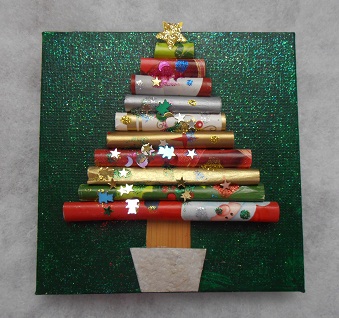
Darling Precious Roly Poly Christmas Tree

What you will need: various coloured Christmas papers, glitter, egg carton, bark, scissors, a rounded pencil, glue stick, PVA /craft glue, a small canvas board, paint in your favourite Christmas colour (green, red, silver or gold look great), glitter glue pens, sparkly stars/shapes, glitter paint, yellow star sticker, newspaper/plastic table cloth to cover surfaces.
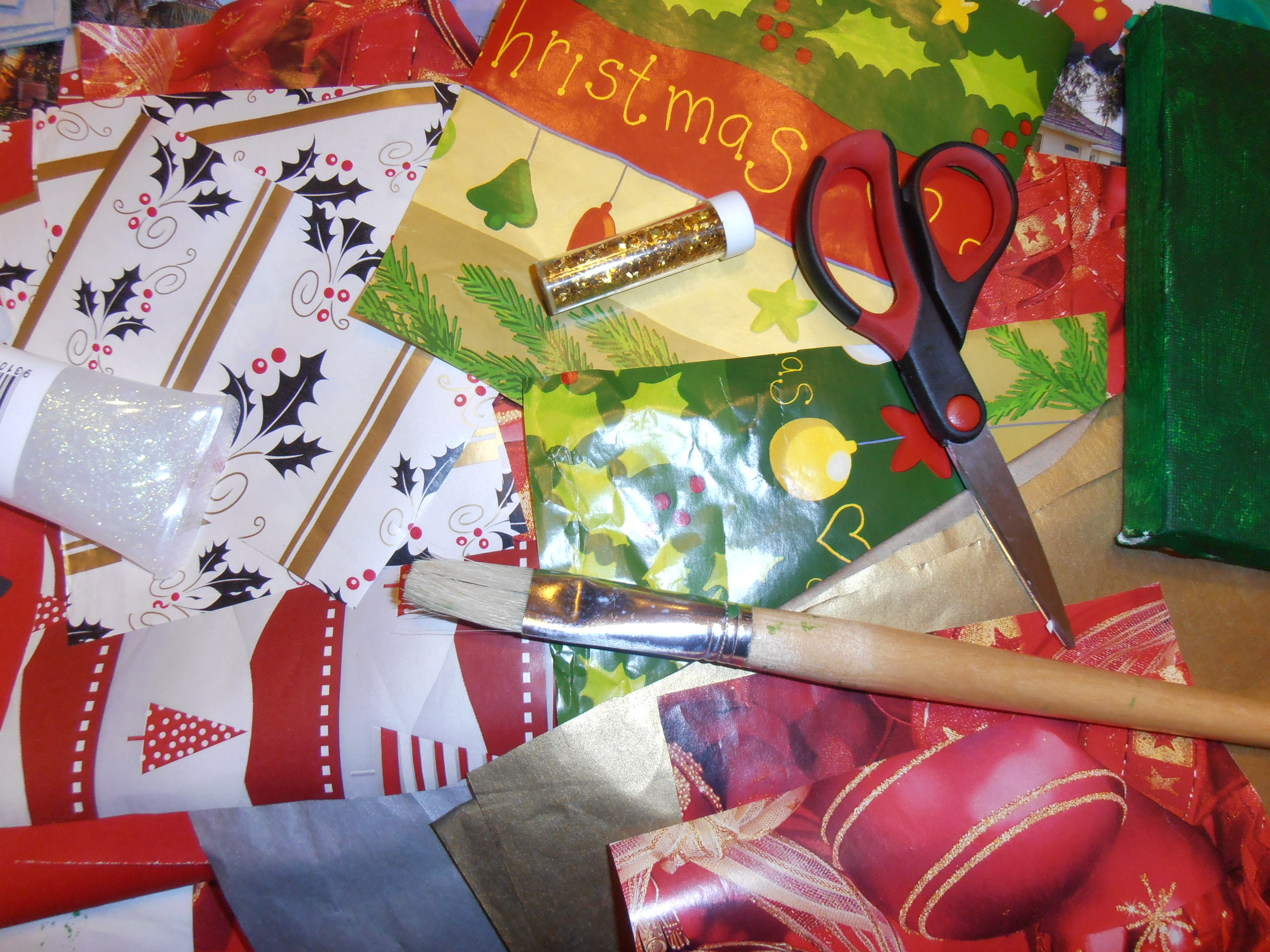
What you will need to make a Roly Poly Christmas Tree

Step 1 – Get all the items you will need organised and ready to go then cover your working area with newspaper or a plastic tablecloth.

Step 2 – Paint your canvas using non-toxic paint in one of your favourite Christmas colours such as red, green, silver and gold.
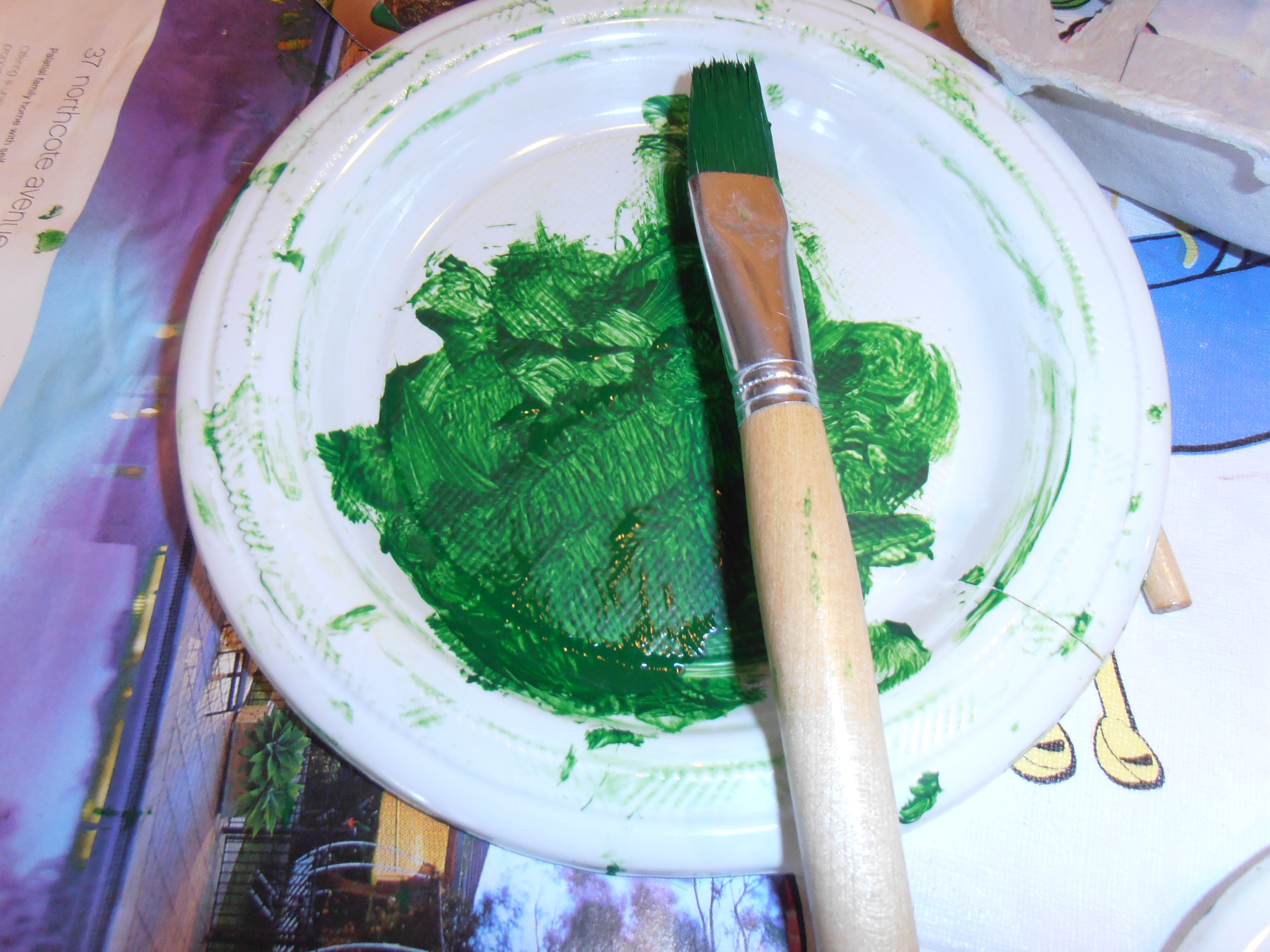
Choose your favourite coloured Christmas paint

Paint your canvas board in your Christmas paint

Step 3  – When your paint is dry, cut a piece of the bark (Palm tree bark works well) into a trunk and stick it on the lower centre of your canvas board using PVA/craft glue.  Then cut a basket out of your egg carton and stick this on the bottom centre of your board, just covering the lower part of your bark trunk.


Glue your bark trunk and egg carton basket on with PVA/Craft glue

Step 4 – Cut a variety of Christmas papers into rectangles of about 10cm by 10cm. Then use a rounded pencil/twist crayon to roll your paper rolls, beginning at one end  and rolling the paper around the pencil until about 3cm from the end. To finish off your paper roll, place glue using your glue stick near the end section of your paper and then keep rolling until your paper roll is complete.

Roll your Christmas paper by placing your rounded pencil/twist crayon at the beginning of your paper and rolling until you only have about 3cm left.

Use a glue stick.
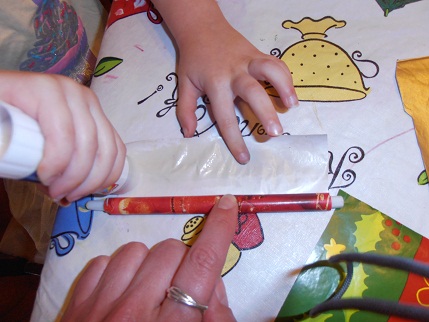
Put glue on the last 3cm of your paper roll and then continue rolling until it is sealed.

Step 5 – Continue rolling different pieces of paper until you have about 8 or 9  paper rolls then cut each down to size. Begin with one that is about 1-2cm shorter than the canvas board on each side. Then continue cutting each a cm or 2 shorter than the last. The final one should be about a 1cm wide.  Rearrange the paper rolls on the canvas board to get them into the right order then move them to the side, keeping the same order.

Rearrange the rolls of different patterned Christmas paper into order before you do any gluing so that you have them the way you want them.

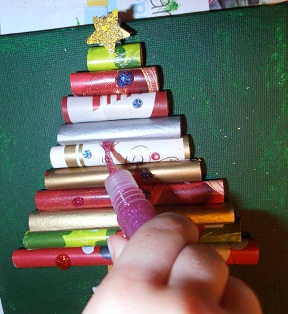
Step 6 – Squeeze a line of PVA/craft glue onto where the paper rolls join is and then glue the longest one to the top of your bark (centred), then the next longest, and so on and so on until you have the smallest paper roll on top. Continue to cut in order to get your sizing right if necessary.

Start by gluing the longest paper roll to the top of the bark, then proceed with the next longest and so on and so on until you have the shortest paper roll on top.

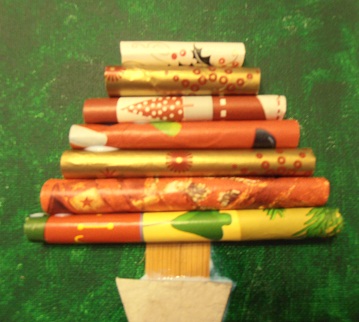
Continue until you have all paper rolls firmly secured with PVA/craft glue.

Step 7 – Cover a yellow sticker star with glue and then sprinkle with glitter. Carefully peel sticker from backing then add a drop of PVA/craft glue to the top roll on your Roly Poly Tree and stick glitter star on.
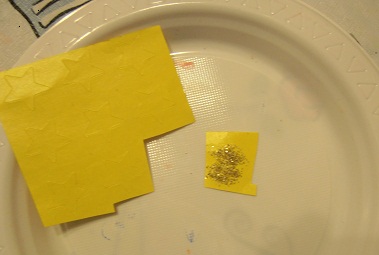
Step 8 – Use glitter glue pens and metallic sparkly shapes to decorate your tree.

Step 9 – Paint the canvas around your Roly Poly Christmas tree in glitter paint with a brush.
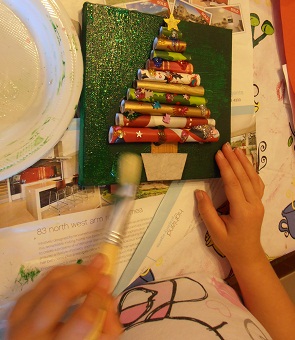
Paint your canvas area with glitter paint e.g on the green area on this one.

Step 10 – Your Roly Poly Christmas Tree is now complete so place it somewhere where everyone can see it and enjoy this fabulous Christmas season!

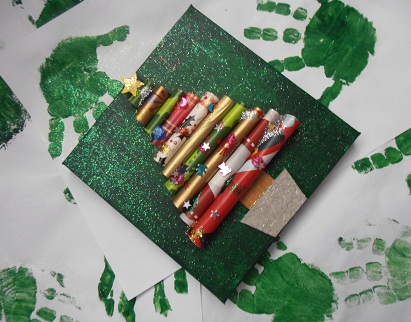
This activity is not only lots of fun but also great for comparing, sorting and ordering in relation to length and for developing fine motor, hand-eye coordination,  and creativity. So get your darling precious children, cutting, rolling, gluing, painting, and designing!!!

Happy guiding and a peaceful Christmas from,

Darling Precious Children

By darlingpreciouschildren Posted in Christmas

The Importance of Building Confidence

Most people know that having confidence is a valuable asset to have in life but do you realise just how much of your life it actually affects? It has been proven by many theorists, psychologists, teachers and specialists that confidence – or lack of – affects almost every part of your life.  This is especially true when it comes to children.  A child’s ability to attempt tasks that challenge them relies heavily on their level of confidence. Children who are lacking in confidence generally have a lower self concept and self-esteem.  This leads to feelings of inadequacy and not believing that they can achieve their goals, therefore they give up on having any.  But even worse still –  there is  evidence to suggest that this could possibly lead to stress, depression and anxiety.

Self-esteem has far greater impact than intelligence or ability!

According to Apter, a social psychologist; children’s successful development depends on their self-esteem.  She adds that this has a far greater impact than intelligence or ability. Children, who are confident, believe that they have value.  They also have higher expectations, persist longer in tasks, and in general display more advanced skills than equally able but less confident children.  A child with little confidence can appear to be behind in their development but with assistance and encouragement this lack of self confidence can be overcome and their level of competence in most tasks increases. 

Fear of trying new things, making choices and failure!

With the development of self confidence comes the development of high self-esteem.  Psychologist Coopersmith, who has extensively researched self-esteem, says that people with low self-esteem are afraid of trying anything new; are unable to make decisions and are sure they will fail.  This is clearly evident in Erikson’s psychosocial stages of development. Erikson’s Initiative versus guilt (3 to 6) stage relates to the way a child develops initiative when trying out new things and is not overwhelmed by failure.  If children are not given the opportunity to develop initiative then they develop guilt which leads to feelings of inadequacy. 

The links to anxiety, depression and stress!

Children who are afraid to try anything new in case they fail may become adults who will not attempt new challenges for fear of failure.  Life without challenges can become mundane and gloomy which (along with other contributing factors) may lead to developing anxiety and depression.  Consequently, stress can also become a result of low self confidence.   Stress is the body’s reaction to fears, assumptions, and worries that we summons into our minds.  The more we stress, the more insecure we become about our own coping abilities, and the result is lower self esteem.

Confidence: the key to reaching your full potential!

If we are to have the best chance of developing good emotional well being, all human beings need the opportunity to increase their level of confidence.  In doing so, the onset of some emotional disorders such as stress, depression, anxiety, low self-esteem, etc may be reduced.  Confidence is also essential to living our best lives possible and reaching our fullest potential! How can we aim for anything if we have no belief in ourselves that we can achieve all that we desire?  Confidence gives you the power to hope! Therefore, it is imperative to nurture and develop confidence in all children and facilitate a desire for new challenges.

Happy guiding,

Darling Precious Children

P.S

Checkout my previous blog: Stop Comparing Children! And stay tuned for my next blog: Developing Your Child’s Confidence,  for more insights into positive child guidance!

Stop Comparing Children!

Stop Comparing

Why is it such a far fetched idea that we could possibly be happy just being ourselves? Why do people have to constantly compare every physical, mental, social, emotional aspect of ourselves and our lives to each other? And why do we place such importance on what the media consider to be normal? Who cares! Stop comparing! We are not each other, we are unique amazing individuals and we shouldn’t even be trying to be like someone else’s so called “normal.” Being the best version of ourselves should be our ultimate goal not being “normal” – there is no such thing!

Don’t judge a fish on it’s ability to climb a tree!

I saw a great quote recently by Einstein – a truly wise and intelligent individual – and it said “Everyone is a genius but if we judge a fish on it’s ability to climb a tree, it will live it’s life thinking that it is stupid.” So true! Break the cycle and don’t put your children through such an unrealistic, hopeless and negative endeavour. You should want them to be themselves, they are precious and special they are not everyone else and they should not be expected to be. Outdated school systems with their harmful and unnecessary grading method only serve to perpetuate this myth that we are all supposed to achieve the same things at the same time and if we don’t we are a failure. How does a ‘d’ grade say anything to a child other than you are not good enough, you didn’t keep up with the crowd? They are not sheep, they are children. When we persist in grading a child against all others in their class, we are telling that child that their worth is measured only in terms of how successful they are in comparison to their peers. Instead we should be doing all we can to develop each child’s confidence not annihilate it! They all have their own brilliant unique talents – nurture this!

Give them a break!

Children are not only being compared to each other at school either – some parents do it too! The ones that are meant to be building them up are knocking them down. For some bizarre and totally insane reason that I do not understand, people are comparing when their children first sat up, crawled, walked, talked, potty trained, counted, read and so on and so on. All it does is keep this cycle of comparison going and going. I’ll let you in on a little secret – Children do not all develop the same skills at the same age – Give them a break! All this talk just instils fear and an inferiority complex in yourself, it is unproductive and totally unnecessary. It places way too much pressure on your child and sets you and your child up for a lifetime of failure because you will always be trying to live up to others expectations.

Your Child is Unique!

So why start with this topic? If we are going to talk about nurturing your child’s unique amazing spirit then we have to get rid of all those perceptions that your child should be anything other than themselves. To do this you may have to look introspectively at yourself and let go of all you have learnt before now. Welcome to Darling Precious Children!